
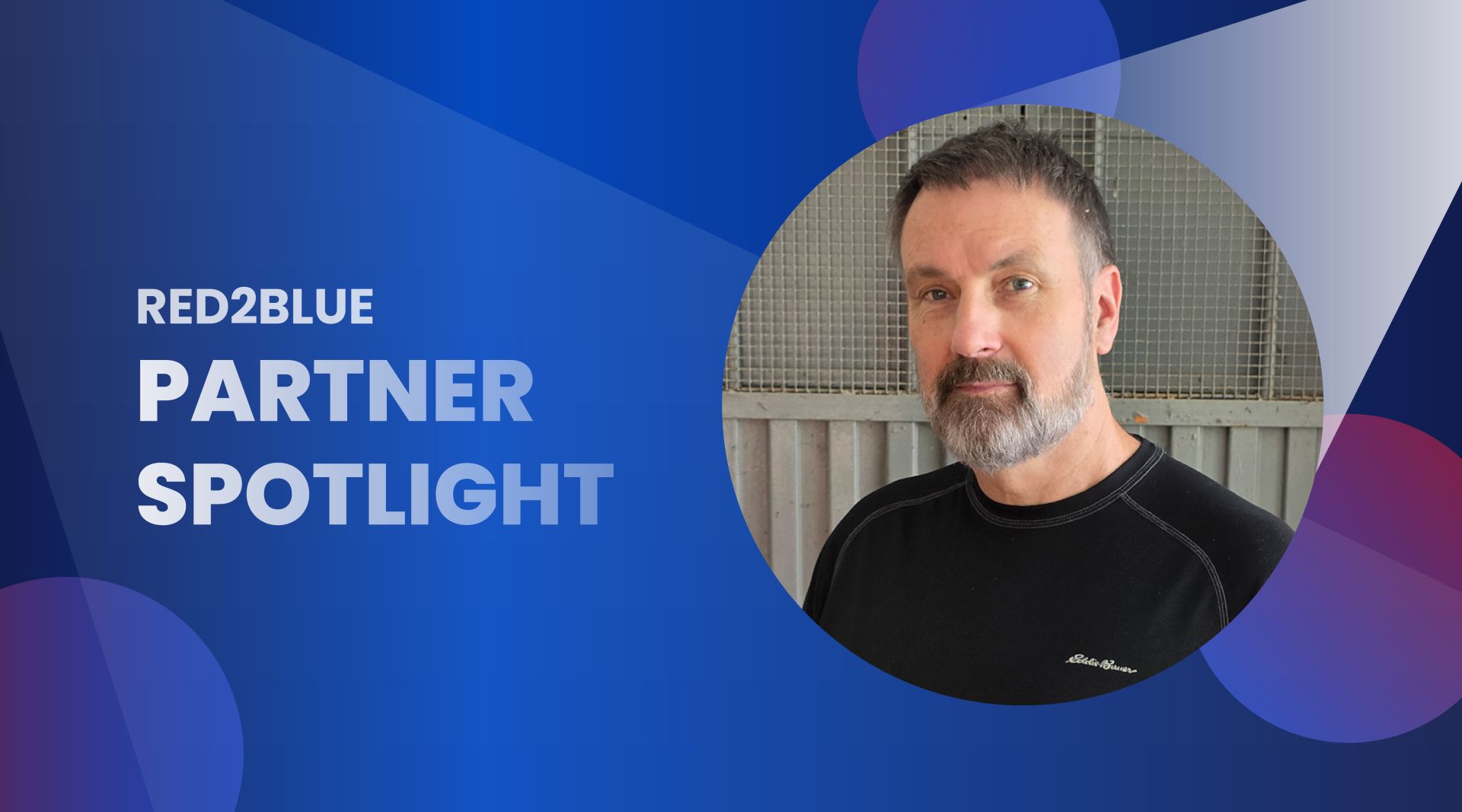
Peter Brenchley is one of our partners specialising in Red2Blue for Business. He now works with emergency services and business leaders, helping them to perform under pressure using Red2Blue. His work has included professional footballers, rugby teams and senior fire service commanders, alongside a growing roster of business clients.
Few coaches arrive at Red2Blue with quite as varied a back catalogue of pressure as Peter Brenchley. He trained as a civil engineer, then spent eleven years as a firefighter in New Zealand.
Civil engineering infrastructure projects, he explains, have a surprising number of high-pressure points: "You've got multiple teams coming in, the police have closed the road, you've got contractors, you've got your own people, you're trying to put a pipe through somewhere and there's something there that's not on the plans," he says. "What do we do now? That's a pressure situation. It's not what you'd expect, but it's pressure nonetheless."
Civil engineering infrastructure projects, he explains, have a surprising number of high-pressure points: "You've got multiple teams coming in, the police have closed the road, you've got contractors, you've got your own people, you're trying to put a pipe through somewhere and there's something there that's not on the plans," he says. "What do we do now? That's a pressure situation. It's not what you'd expect, but it's pressure nonetheless."
From there, Peter built and sold a tech startup, then progressed from director to vice president before becoming general manager of a global business line within a US hospitality tech company. "Each time I started from zero again," he says. "Shifting careers from civil engineer to firefighter to tech startup, those are opposite ends of the spectrum – and there's a whole lot of discomfort and pressure that comes with having to start fresh."
It's this breadth of experience, rather than any single career, that Peter believes makes his coaching unique. "I've experienced pressure in the boardroom, talking with investors and CEOs, in sports, in a startup pitching my services, and then on the other side of the table having someone pitch to me. That breadth of experience gives me a practical understanding of pressure across very different environments, rather than having stayed in one lane throughout my career.”
Discovering Red2Blue
Peter first heard about Red2Blue through New Zealand rugby. "I know the Crusaders Super Rugby team had used it for a long time," he says. He remembers watching a rugby chat show discussing a player, Bryn Hall, who'd struggled for game time at the Auckland Blues but transformed his form after moving south to the Crusaders. A former All Black on the panel put it down to the fact that "they build people down there."
"That phrase stuck with me,” Peter said. “What does 'build people' actually mean? That's what led me to Gazing Red2Blue." "
Why Red2Blue, specifically?
Having spent time around a famously hard-to-impress crowd – firefighters – Peter is clear about what sets Red2Blue apart from other mindset training programmes. "Imagine going in there and trying to teach a group of firefighters about mindset. It has to be practical and credible, or it simply won’t land. Red2Blue stands that test, because it isn’t just theory, it’s a clear system with tools people can actually use."
He points to the ‘What Ifs’ – a Red2Blue tool that helps you work through scenario planning – as an example. "If you do your What Ifs every day, it's remarkable what you get from it. It's not just talk." He describes Red2Blue as one of the few programmes genuinely fit for purpose. "A lot of mindset training remains at the motivational or conceptual level – this doesn’t.”
As a trained engineer, that practicality matters to Peter. "It's about looking at what we have to work with and finding a solution. Then you've got the firefighter in me too. My favourite line from Toto Wolff, the Mercedes F1 team principal, is ‘nothing gets on the car that doesn't help us go faster.’ That's the same test. There's nothing in Red2Blue that doesn't help us to go faster."
Using the common language
For Peter, the real proof that Red2Blue is working is not just in the grand transformations, but in the moment when people start using the language themselves, often light-heartedly. "When people are digging at each other, and one says, 'you're going a bit red head there,' that's when you know it's working. They're not using it in a flippant way, but in in a light-hearted manner. That's good to observe because it signals that the language has become part of how the team now operates. It also brings down the pressure in the moment. It's not such a big deal anymore. We're able to talk about it."
He sees this as particularly powerful in teams that don't think of themselves as operating in dangerous environments but are nonetheless working under sustained pressure. "In the fire service, you go into a job together and it forges a bond. In business, we don't talk about pressure that way, but people do say things like 'I was firefighting all day in the office.'
The environment is different, but the underlying human dynamics are the same. When a customer care team going through a wave of complaints begins to see it as a shared pressure experience, it creates a stronger sense of team. “There’s a great deal to be gained when people learn to recognise the pressure, accept it as a normal part of their environment and choose how to act together as a team,” Peter says.
Small margins, big numbers

Copyright © Gazing Limited 2025