
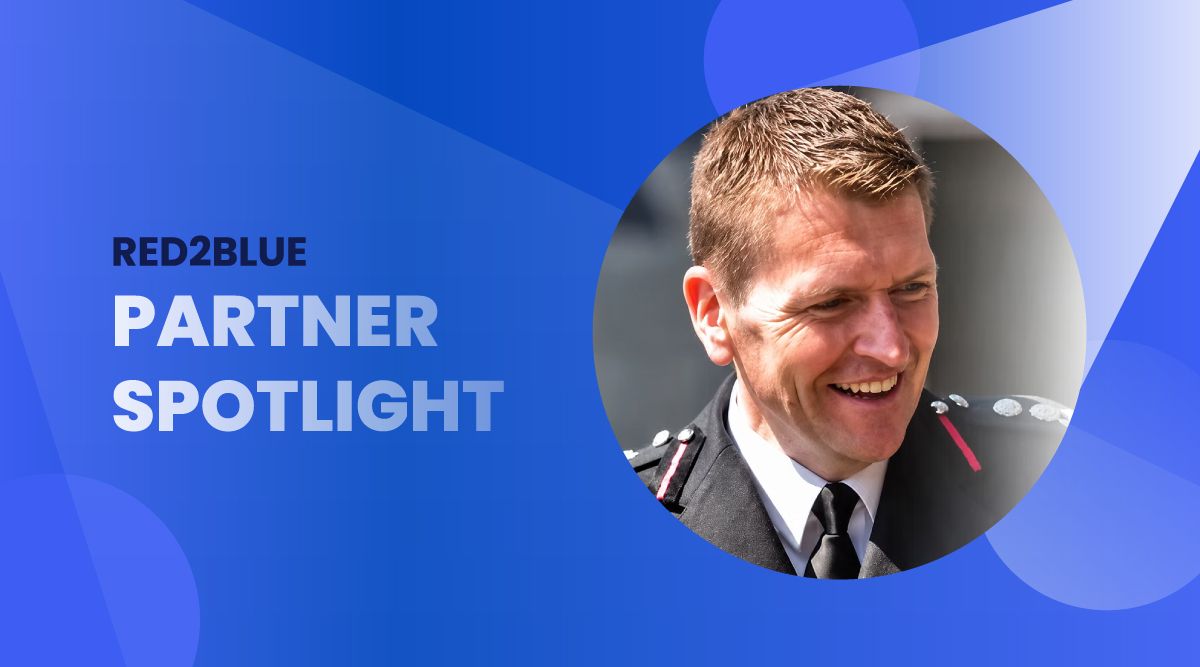
Gavin Watts is a former Chief Fire Officer with 30 years' experience in fire and rescue. Having served in West Sussex, including as Gold Commander during the devastating Shoreham Air Show crash in 2015, Gavin now brings Red2Blue into his coaching work with the Fire Service College. We chatted to him about how he uses Red2Blue to help fire crews at every level understand that technical training alone is never enough.
Gavin knew all about Red2Blue thanks to a long-standing friendship with Gazing’s Ian Cochrane, so when Gavin retired in 2019, undertaking the Red2Blue programme was top of his list. "I'd always been very interested in developing staff and the training we did for them," he says. "But when I look back, we never did anything on mindset. We had standard operating procedures and structures coming out of our ears. We trained on the drill yard every day. We never gave a thought to mindset."
Telling people what not to do
That gap, Gavin reflects, was apparent from early in his career. When he was coming up through the ranks, the advice around managing high-pressure situations was often frustratingly vague. "People would always say, 'Make sure you don't get tunnel vision,'" he recalls. "And I always used to think, well, okay, you've told me what not to do, but you haven't told me how to do it." He heard plenty about the risks of information overload and narrowing perception, yet nothing about how to actually manage it. "They gave you all the symptoms, but no option for a cure."
As fire and rescue services grew more aware of the psychological impact of attending serious incidents, the focus shifted towards post-incident support: counselling, debriefs, mitigation after the fact. What they never did, Gavin says, was go upstream. "We didn't think, can we give our people a bit more resilience beforehand?"
Command presence while remaining approachable
Now, working with the Fire Service College at Moreton-in-Marsh, Gavin delivers Red2Blue across a structured series of sessions tied to promotional courses. The first, aimed at newly promoted crew commanders, focuses entirely on the individual. It's a significant transition: one day you're part of the team, the next you're in charge of it.
"As a firefighter you don't have any command decisions to make, you're doing what you're told. And then overnight that changes," he explains. "You know the people you're working with. You've been working side by side with them, and the next day you're in charge. That brings expectations, scrutiny and consequences and the pressures associated with those elements."
"As a firefighter you don't have any command decisions to make, you're doing what you're told. And then overnight that changes," he explains. "You know the people you're working with. You've been working side by side with them, and the next day you're in charge. That brings expectations, scrutiny and consequences and the pressures associated with those elements."
The concept Gavin spends time on at this level is what fire and rescue now calls "command presence" – how you are seen and read by others when under pressure. "You have to present yourself in a calm, controlled way, even if inside you're churning," he says. "I've been there, scratching my head, wondering what I'm going to do. But it's really important that your troops don't see that."
At the same time, he is careful to flag that command presence shouldn't tip into untouchability. There is a balance between projecting composure and remaining open to advice.
At the same time, he is careful to flag that command presence shouldn't tip into untouchability. There is a balance between projecting composure and remaining open to advice.
The Red2Blue language as a neutral framework
The next level up, Watch Commander, shifts the focus outward. Here, Gavin explores how Red2Blue can be used to manage a whole team's performance, including how to hold difficult performance conversations using the language of Red2Blue as a neutral framework. He also spends time on the hot debrief – the quick review that takes place immediately after an incident, before crews return to the station.
"I've been involved in loads of those, and they have often been less than effective or useful," he says. "Everybody's tired, they want to go home, they're wet, they're cold, they're not paying attention."
Using the structure of the Mental Cross Check, he shows commanders how to get real focus in a very short space of time, and how having a recognised trigger, such as saying "blue heads on" can reset a group quickly and effectively.
Using the structure of the Mental Cross Check, he shows commanders how to get real focus in a very short space of time, and how having a recognised trigger, such as saying "blue heads on" can reset a group quickly and effectively.
"I've gone red, and I need to get back to blue"
The risk of inexperience
Stay grounded and be yourself

Copyright © Gazing Limited 2025